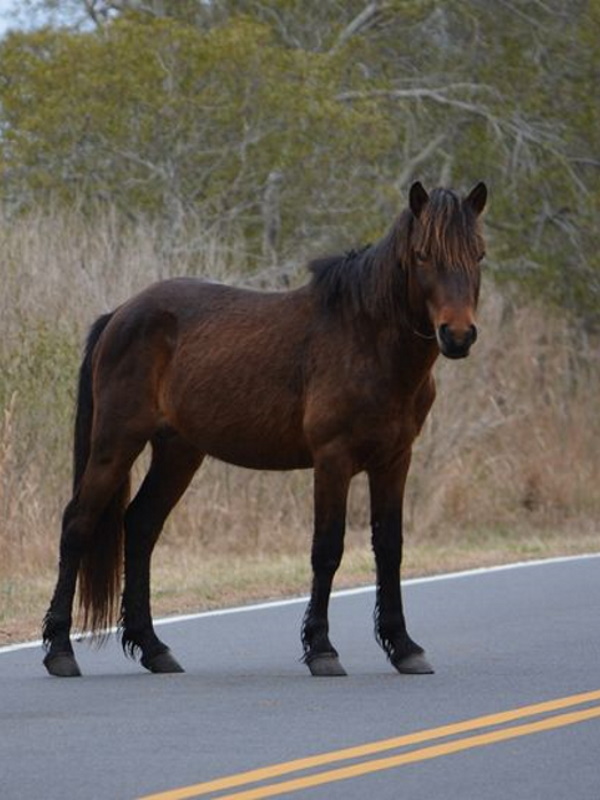
Photo by National Park Service
Chip
When “Just One Snack” Costs a Wild Horse His Home
Chip, Susi Solé, and Why Protecting Assateague’s Horses Is About More Than the Road
Most people who feed a wild horse probably do not believe they are doing harm. They see an animal they love: a horse approaches a picnic table, investigates a cooler, or walks toward an open trunk. Maybe someone offers a small snack because, in that moment, it feels harmless. It may even feel like a special connection. But for a wild horse, those encounters can change behavior in ways that last long after the visitor has gone home. Assateague has already seen what can happen when that pattern goes too far. His name was Delegate’s Pride—better known as Chip—and his story has a particularly painful connection to why Assateague Horse Safety exists today.
Delegate’s Pride, N6ELS-H, was a stallion in the Maryland herd and the former stallion of Susi Solé, N2BHS-M. Assateague Island Alliance’s horse records document four foals produced by Susi and Chip together: Seases Bay Breeze (“Breezy”), TJ Hollywood, Chief, and Maximus Murphy. Susi later joined Billy Bob’s band and produced additional foals with him. That family connection matters. In 2022, Chip permanently lost his home on Assateague after human-related food conditioning contributed to increasingly dangerous behavior. Four years later, Susi was lost in a vehicle collision on the island, one of the recent incidents that helped ignite the concern from which Assateague Horse Safety grew. Their circumstances were very different, and we should never blur one incident into the other. But together, their stories illustrate something important: horse safety is bigger than one road, one rule, or one type of incident. The way people behave in the horses’ habitat matters.
On May 2, 2022, the National Park Service announced that Delegate’s Pride would be permanently removed from Assateague Island National Seashore and relocated to the Cleveland Amory Black Beauty Ranch in Murchison, Texas. NPS described Chip as highly food-conditioned and increasingly aggressive toward visitors and park employees while pursuing human food. According to NPS, beginning in 2017, Chip was involved in more than half of all horse-related incidents that resulted in visitor injury. Park officials also reported that the non-contact techniques normally used to encourage horses away from dangerous situations had become largely ineffective with him. Ultimately, NPS determined that permanent relocation was necessary. Chip was removed from the island, and he did not return.
A horse that becomes accustomed to seeing people is not necessarily tame. NPS distinguishes that kind of habituation from something potentially more dangerous: food conditioning. A food-conditioned animal learns to associate people or human environments with food. NPS warns that this can happen when visitors deliberately feed wildlife or unintentionally allow access to human food through improper storage. For an Assateague horse, the lesson can become very simple: people mean food. Cars, coolers, picnic tables, campsites, and open trunks can all become associated with that same lesson. That is why this is not only about someone deliberately handing a horse a sandwich. An unsecured cooler can teach the lesson. Food left unattended can teach the lesson. Allowing a horse to raid a campsite can reinforce the lesson. Once a wild animal strongly associates people with food, NPS says reversing that behavior can be extremely difficult.
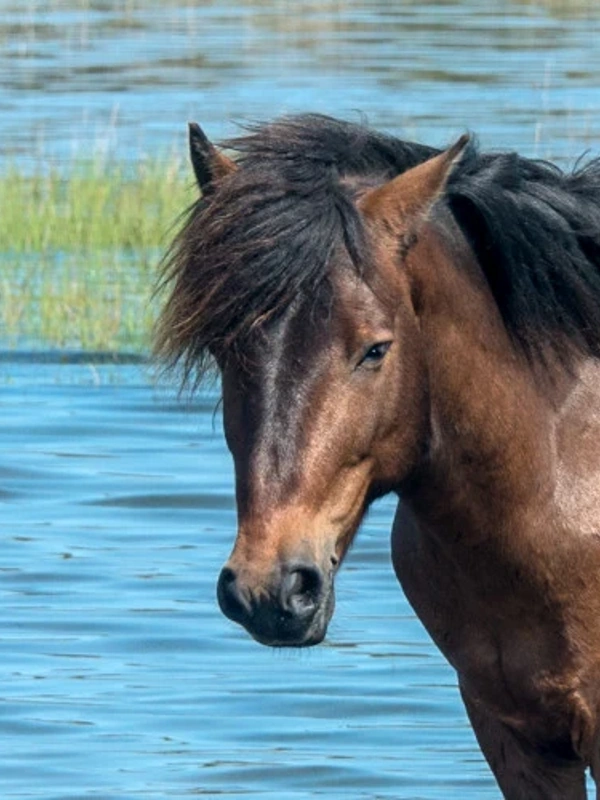
Photo by Assateague Island Alliance
This is where the issue becomes even bigger. NPS specifically warns that feeding and petting Assateague horses can cause harmful behavioral changes. Horses may begin approaching people and vehicles, become increasingly aggressive, and spend more time near roads. NPS states that horses attracted to roads face an increased risk of being injured or killed by vehicles. Feeding, campground behavior, and roadway safety therefore cannot always be separated into unrelated categories. A horse that has learned that cars equal people and people equal food may become more willing to enter the very environments where human-wildlife conflict is most dangerous. That is one reason Assateague Horse Safety looks beyond vehicle collisions alone. The road may be where one tragedy happens, but the chain of risk can begin somewhere else entirely.
There is another piece of Chip’s story that deserves attention. Wild horses do not live as isolated individuals. Assateague horses have a complex social structure and live in bands, and NPS describes those bands as having harem stallions whose role includes protecting their mares. Chip had a band, mares, and offspring. AIA’s historical record describes his food aggression as a hazard not only to visitors and Chip himself, but also to his band. Permanently removing him was therefore not simply a matter of transporting one problematic horse from Maryland to Texas. A member of an established social group disappeared from that group. We should be careful not to claim exactly how every horse in Chip’s band reacted or reorganized afterward unless records document it. Wild horse relationships change naturally over time, and bands can reorganize. But removing a stallion necessarily changes the social environment of the horses left behind. Chip lost his island home, his band lost one of its members, and that makes the consequences of food conditioning larger than one horse.
This is where stewardship becomes very practical. Sometimes park rules can feel like a list of things visitors are being told not to do: don’t feed the horses, don’t touch them, stay back, close the cooler, guard your food, and move away if a horse approaches. But those rules are not arbitrary obstacles standing between visitors and an amazing wildlife experience. They help preserve the wildlife experience. Current NPS campground regulations state that touching, feeding, or enticing Assateague horses is illegal. Visitors observed within 40 feet of a wild horse may be subject to a minimum $100 fine. Food and beverages must also be securely stored when they are not being used and closely guarded when they are out so horses and other wildlife cannot access them. Current NPS safety guidance makes another important point: if a horse approaches you, that does not mean the distance rule disappears. You back away. NPS puts the responsibility plainly on the human visitor to restore a safe distance and help keep wildlife wild.
The person who gives a wild horse food may be off the island a few hours later, but the horse stays. The next family may encounter the horse that now expects food. The next camper may find that horse investigating a cooler. The next person opening a car door may suddenly have several hundred pounds of determined horse standing beside them. The next ranger may have to intervene. Every successful food encounter can reinforce the behavior again. The person who started or contributed to that pattern may never see where it eventually leads. The horse does. Chip did. That is perhaps the hardest part of his story.
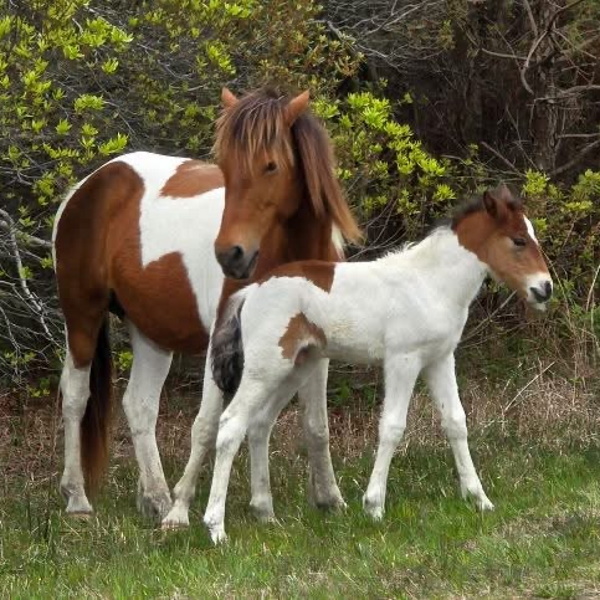
Photo by Lynn Weaver
For people who have followed the Assateague horses for years, the relationship between Chip and Susi makes this history especially poignant. They were once part of the same band structure, and together they produced four horses whose lives continue the family line. Then two very different human-related safety issues changed that family history. Chip was removed from Assateague, while Susi was later killed on an Assateague roadway. One involved long-term behavioral changes associated with human food; the other involved a vehicle collision. They were different circumstances, different management questions, and different kinds of loss. But both remind us why protecting these horses requires looking at the whole environment in which horses and people interact. Roads matter, but so do campgrounds. Food storage matters. Visitor distance matters. Pets and harassment matter. Education matters. Enforcement matters. And stewardship matters.
At Assateague Horse Safety, we use the word stewardship deliberately. It can sound like a big concept, but in practice it often comes down to very small decisions. Stewardship means recognizing that we are visitors in their habitat and that our choices can change the lives of the animals who remain after we leave. Sometimes stewardship means moving twenty feet farther away than you wanted to. Sometimes it means giving up the perfect photograph or explaining to a child why the pony cannot have a snack. Sometimes it means closing the trunk, locking the cooler, picking up spilled food, or reminding someone—kindly—that these horses are wild. None of those things feels dramatic, and that is precisely the point. Good stewardship often prevents the dramatic thing from ever happening.
There is something extraordinary about standing on Assateague and watching a horse live freely in the place it belongs. People learn their markings and their names. They follow their bands, watch foals grow, and photograph the same horses year after year. That connection can be profound. But loving a wild horse cannot mean changing that horse to make the encounter better for us. NPS warns that treating wild horses like tame animals takes away the very wildness that makes them special. So photograph them. Learn about them. Follow their stories. Love them. But give them what they need from us most: space, respect, and the freedom to remain wild.
Chip’s story is not simply the story of a “bad” or aggressive horse. It is the story of what can happen when a wild animal learns that humans provide food and that behavior becomes so deeply established that management choices become painfully limited. Because we now know what happened to Chip, we cannot say we were never warned. Sometimes protecting an Assateague horse really does begin with something as ordinary as closing the cooler, stepping back, refusing to offer the snack, and following the rule. Keeping Assateague’s horses wild is not only the responsibility of the people who manage them. It belongs to every one of us who is privileged enough to enter their home.